Funded by their community · Lawrence, NY
Flower Turbines closed a $743,500 community raise to fund its first commercial wind installations
A vertical-axis wind company turning 266 investors into the funding source for rooftop and campus projects
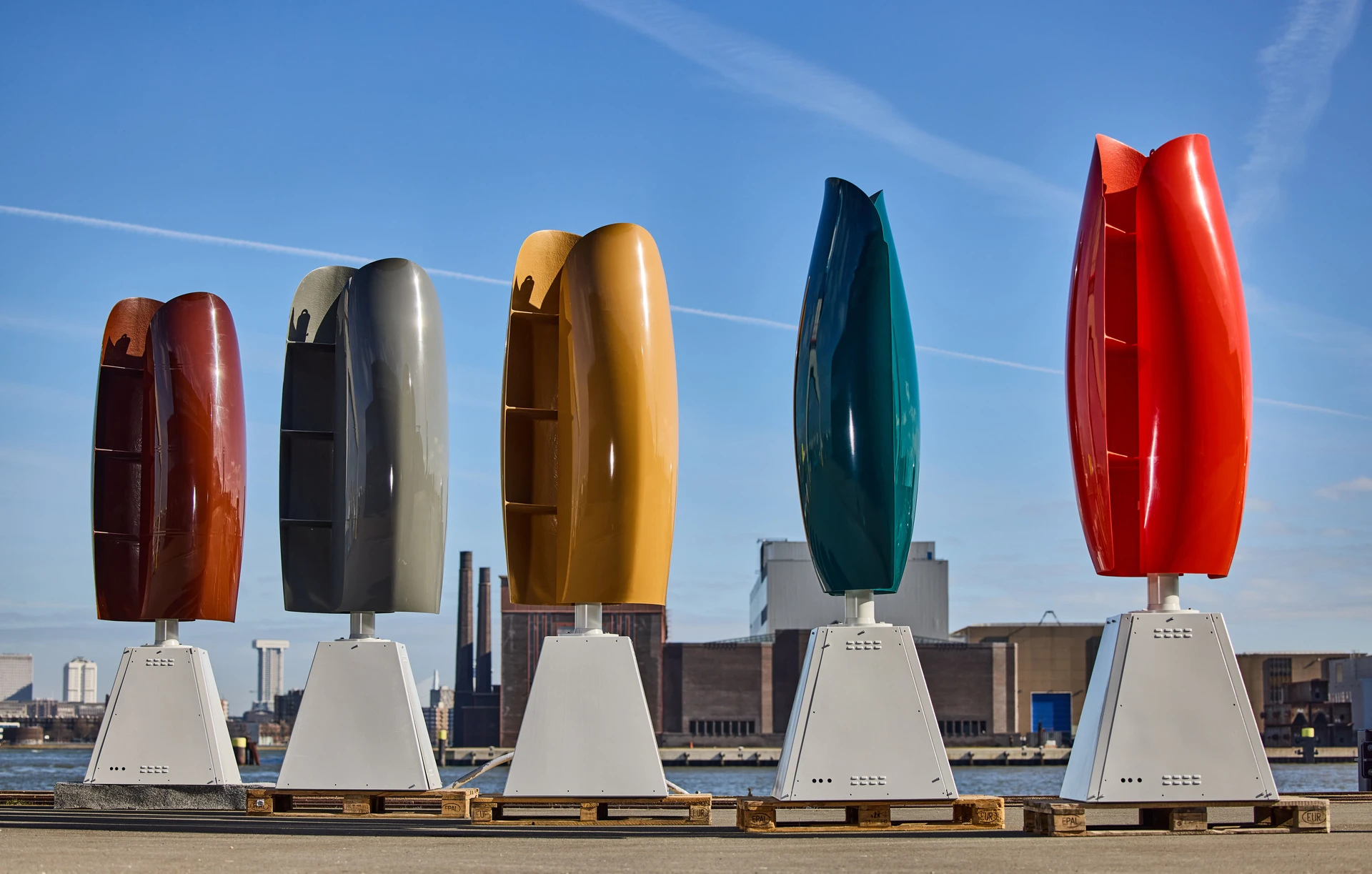
A wind turbine shaped like a tulip
The turbines look like tulips. That is the first thing to know about Flower Turbines. The blades curve up from a central stalk in a vertical-axis design, and when several of them stand together on a rooftop or a campus lawn, they look more like a sculpture garden than a wind farm. The shape is not decorative. It is the reason the company exists.
Flower Turbines, based in Lawrence, New York, builds small vertical-axis wind turbines for commercial sites — rooftops, campuses, industrial facilities. The traditional three-blade turbine the reader pictures when they hear the word “wind” is built for open land and high, steady wind. It is loud, it is hazardous to birds, and it does not work well in the kind of turbulent, lower-speed wind that moves around buildings. The tulip-shaped vertical-axis design is the company’s answer to that gap. It runs quieter, it does not chop, and it performs in wind speeds that would leave a conventional turbine standing still.
The more interesting claim is what happens when the turbines are clustered. The company calls it the bouquet effect: planted close together, each turbine improves the airflow around its neighbors, and the group produces more power than the same turbines would standing alone. For distributed wind — the idea that businesses might generate their own electricity on-site rather than draw it from the grid — that is the unlock. Rooftop and campus installations only pencil out if you can fit enough capacity into a small footprint. The bouquet effect is what makes the footprint work.
Why a community raise instead of a project-finance loan
The capital question for a company at this stage is not whether the technology works. It is how to fund the first commercial installations at sites where the technology can prove itself on someone else’s roof, generating real revenue under real conditions. That is a hard ask of a traditional project-finance lender, who wants to see a long track record of installed-and-operating projects before underwriting the next one. The company that has not yet built the proof points is in a chicken-and-egg position with conventional capital.
A community-funded raise solves a different problem than a bank loan does. The 266 investors who put $743,500 into this offering are not waiting on a decade of operating data. They are buying into the thesis that distributed wind has a place on commercial rooftops and that the bouquet effect is the engineering reason it will work. The capital lets the company build the projects that produce the operating data the next round of lenders will want to see.
The structure also matches what the company is selling. Flower Turbines is targeting commercial sites with high electricity costs and good wind resource, signing power-purchase agreements that let the host buy clean power at a discount to grid rates. The cash flow from those agreements is what funds dividends back to investors over time. The mechanism is direct: investor money builds the turbines, the turbines generate power, the power generates revenue, the revenue flows back.
266 investors, $743,500, and a project pipeline
The raise opened on August 6, 2025 and closed on October 6, 2025 with $743,500 from 266 investors. The company will build as many of its signed initial projects as the funds will support, prioritizing sites where the wind resource and the electricity prices line up. Each installation is a proof point. Each proof point makes the next site easier to sign and the next round of capital easier to raise.
The investor base for an offering like this looks different from the investor base for a neighborhood bakery raise. Some are people who have followed small-wind technology for years and want a way to put money behind it. Some are climate-focused investors who have looked at solar and wanted something else in the portfolio. Some are professionals who found the company through one of its earlier raises and came back for this one. What they share is a willingness to fund the projects before the operating history exists — which is the part of the energy transition that the largest pools of capital are structurally unable to fund first.
The next stretch of work is straightforward in description and hard in execution. Sign the host agreements. Get the turbines onto the roofs and into the ground. Bring the projects online. Produce the operating data. Each commercial site that comes online widens the path for the company to raise the larger project-finance rounds it will eventually need, and gives the 266 investors who funded this round something concrete to point to when the next person asks them what they invested in.
Your turn
Could your business raise like this?
Honeycomb Credit helps small businesses raise capital from the people who already love them. If that sounds like a fit, we’ll walk you through whether your business qualifies.